Indian Telecom Timeline:
Year
|
Major Events
|
1991
|
• The
government allowed private telecom companies to manufacture telecom switches
for telephone exchange
|
1992
|
• The
Department of Telecommunication (DoT) invited bids for licenses for cellular
service across the four metros.
• The
DoT offered two licenses per metro city.
• Rejected
bidder went court; mobile service delayed by three years. First mobile
service was launched in Calcutta in 1995
• Bombay:
BPL Telecom and Maxtouch
• Delhi:
Bharati Telecom and Sterling;
• Calcutta:
Usha Martin and Modi Telstra;
• Madras:
Skycell RPG and Cellular
|
1993
|
• The
DoT commissioned ICICI to study and prepare a report on the possibility of
private participation in the telecommunication sector.
|
1994
|
• National
Telecom Policy, 1994
|
1995
|
• DoT
allowed bidding for cellular licenses and wireline licenses;
• Spectrum
was bundled with the telecom service provider license; country was divided
into 21 circles (excluding four metros)
• DoT
awarded two licenses in each circle; one to the state operator and the other
to the private operator
• The
potential service providers in order to be eligible for bidding for licenses
had to partner up with a foreign company
• Total
34 licenses were issued; The term of the license was fixed at ten years which
was revised to 15 years
• There
was no allocation spectrum but the government levied charges for spectrum
usage as well
• Six
of service providers were in default due to non-payment of license fee by the
early 1997 and by year 1998 defaulters increased to eight
• Bureau
of Industry Cost and Prices (BICP) found that 13 operators were running in
loss. According to ICICI study projection
of revenue by DoT was wrong
• TRAI
studied the cellular operators and come up with New Telecom Policy, 1999
|
1998
|
• Internet
services were rolled out in 1995 by Videsh Sanchar Nigam Limited (VSNL)
|
1999
|
• New
telecom policy allowed the migration of the licensees from a Fixed License
Fee Regime to a Revenue Arrangement Scheme
• Policy
allowed the government as the third operator in the circle
• TRAI
regulated the tariff under the New Telecom Policy, 1999. It brought down the
call tariff from the peak rate of 16.80 to Rs. 6 per minute
|
2000
|
• The
government issued license for national long distance telephony (NLDO)
• There
are 32 companies other than BSNL, the incumbent, which have been granted license
for national long distance services.
|
2001
|
• Licence
for basic telephone services using wireless in local loop (WLL)
• This
was the first time that the first-come-first-serve scheme was implemented for
issuing licenses
• A
bid for cellular license for a fourth operator was introduced in January 2001
|
2002
|
• DoT
issued license to private operators for International Long Distance Telephony
(ILD) services. The license was valid for a term of 30 years
|
2003
|
• Introduction
of calling party pays (CPP). Under CPP, no charges can be levied on receiving
a call in the home circle
• Unified
Access Service Licensing (UASL) regime was introduced by DoT.
• The
UASL “permitted an access service provider to offer both fixed and/or mobile
services under the same license, using any technology.
• The
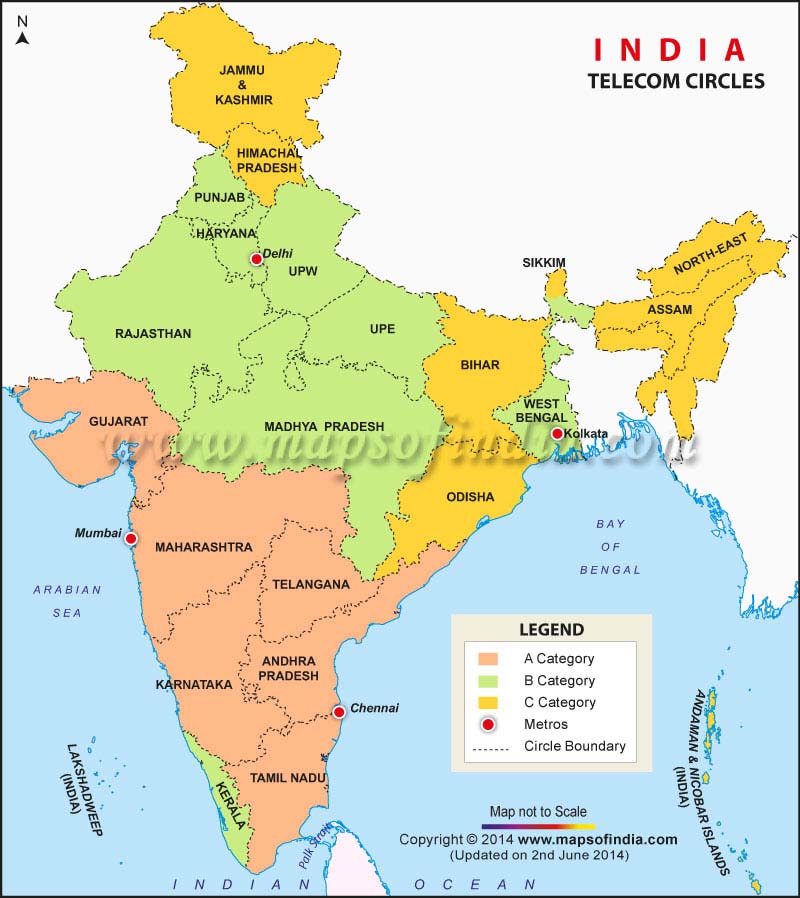
country was divided into 23 service areas, 19 telecom circles and 4 metro
circles for the purpose of implementing unified access services (UAS).
|
2007
|
• DoT
allowed issuing of licenses for operating on dual technologies that is CDMA
and GSM.
• DoT
also allowed single license to Internet Service Providers (ISP) but
restriction was put in VoIP.
|
2011
|
• The
government introduced mobile number portability (MNP)
|
2012
|
• National
Telecom Policy, 2012 introduced Unified Licensing Regime. Under the regime,
service operators can provide converged services.
• The
spectrum has been delinked from the license.
|
Spectrum Auction History:
Year
|
Key Points
|
1991
|
• First
auction initiated in 1991 for 4 Metros – 2 licenses per metro – 900 MHz band
(890-915 MHz paired with 935-960 MHz)
• Each
been allocated 4.5 MHz in the 900 MHz spectrum
• The
cellular licenses provided for an initial spectrum allocation. The licensees
can request the WPC for additional spectrum but allocation is not guaranteed.
• Nov
1994 – 8 CMTS were provided for 4 metro cities to 8 private companies
• Service
started since 1995.
• 1995-1998
: 34 licenses for 18 Territorial Telecom Circles were also issued to 14
private companies
• During
this period a maximum of two licenses were granted for CMTS in each service
area and these licensees were called 1st & 2nd cellular licensees.
• These
licensees were to pay fixed amount of license fees annually based on the
agreed amount during the bidding process. Subsequently, they were permitted
to migrate to New Telecom Policy (NTP) 1999 regime wherein they are required
to pay License fee based on revenue share, which is effective from 1st
August, 1999.
|
2001
|
• Bid
for fourth operator in each circle on first come first serve basis [entry fee
+ 17 % revenue)
• License
for basic telephone services using wireless in local loop (WLL
|
2008
|
• Many
operator got license on 2001 scheme and at 2001 price
• Feb
2012 , Supreme Court of India cancelled many licenses which were given under
this.
|
2010
|
• This
auction was to rollout 3G service and BWA; 2.1GHz & 2.3 GHz band was on
auction
• 2.1
GHz
• It
was new service rollout so 5MHz
(2.5Mhz –paired) block was on auction
• BSNL/MTNL
got allocation be default
• 3
– 4 operators got allocation in each circles
• 2.3
GHz
• BWA
|
2012
|
• This
auction was for 1800 and 800 band – 2G
• None
bid for 800
• 102
out of 140 block went under bid
|
2013
|
• This
auction was for 900, 1800 and 800 band – 2G
• None
bid for 900 and 1800
• SSTL
(MTS) alone to bid for 800 band blocks
|
2014
|
• This
auction was for 900, 1800
• Bharti,
Vodafone were completing 20 yrs (1994) 900 band license
• RJIL
bid in 14 circles for 1800 band blocks
|
2015
|
• This
auction is for 800, 900, 1800 and 2100 band
|